

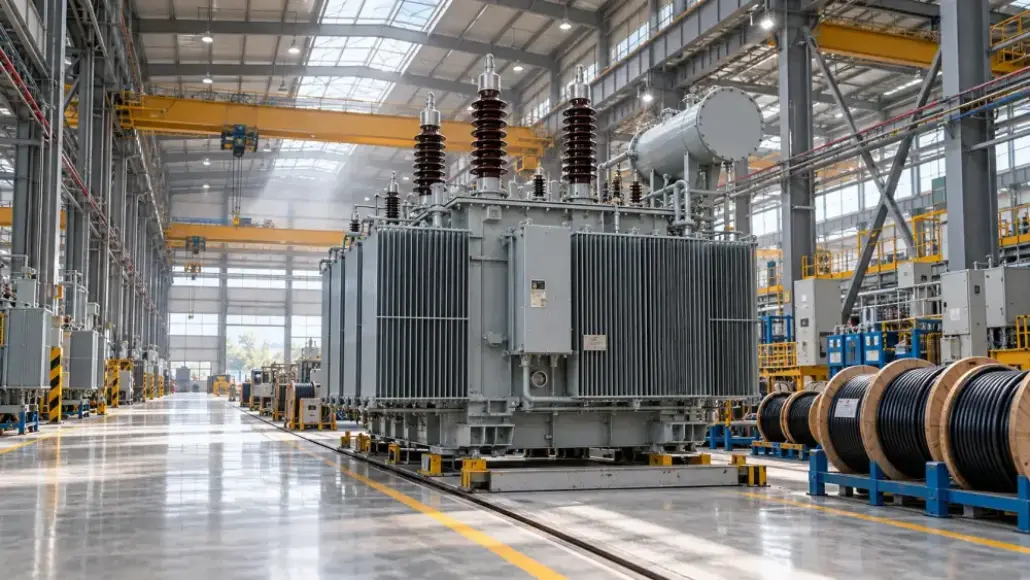

In a recent move that has caught the eyes of many, the U.S. government will allocate $237 million to domestic companies to manufacture electric grid components as the country launches its first Grid Supply Chain Program against a backdrop of soaring demands for computational power.
Energy Secretary Chris Wright announced on October 30, 2026, a Department of Energy program to bolster the durability when it comes to the national power grid and encourage domestic manufacturing of vital components.
Wright said, “DOE is investing in American-made technologies and modernizing our grid to reduce reliance on foreign suppliers and deliver affordable, reliable electricity.”
It is well to be noted that DOE’s Grid Supply Chain Program is seeking project proposals for the first round of funding. The program can provide a maximum of $375 million in federal grants to support manufacturing of electrical distribution as well as power transformers, electric grid components, and critical materials.
The first funding possibility is $237 million in federal grants to build a Grid Supply Chain Alternatives to Lead Energy Dominance – Grid SCALED. Concept papers are due November 20, 2026, and full applications are due February 8, 2027.
Eligible applicants must be domestic entities legally organized in the U.S. and have a physical address where business is conducted in the U.S.
One may apply as either a primary or subrecipient entity: –
- Private companies
- Universities
- Non-profit organizations
- State and local governmental entities and
- Tribes – Indian
As per the DOE, federal investments in projects are intended to spur grid supply chain projects that repair and reuse transformers and various other grid components. The idea is to add to existing inventory faster and cheaper instead of making new ones. The projects will receive as much as $50 million in funding.
The second objective will allocate almost $187 million to accelerate the identification and use of alternative materials as well as subcomponents from U.S. sources by manufacturers of American grid equipment. The final outcome will be to reduce reliance on foreign products.
Katie Jereza, assistant secretary of the Office of Electricity, said, “America should never have to rely on foreign suppliers to keep the lights on. We’re putting American ingenuity to work, developing next-generation grid technologies that strengthen our domestic supply chain, help lower costs, and make our grid more reliable. The power to secure our energy future should be in our own hands.”
DOE is projected to provide additional grants in 2027 to build the supply chain for next-generation technologies like solid-state transformers.
U.S. Power Grid
It is worth noting that the national grid comprises three main areas and linked local grids that channel the electricity circulation from power generators to load centers.
- The Eastern Interconnection – for states that are located in the east of the Rocky Mountains
- The Western Interconnection – States right from the West Coast to the Rocky Mountains
- The Texas Interconnected system
Data Centers Expected to Stress Grid
The North American Electric Reliability Corporation has been watching growing demand for electricity connected to what it defines as computational loads, which is the electricity used by information technology equipment. NERC is a nonprofit international regulatory authority dedicated to reducing hazards to guarantee a dependable and safe bulk-power system. Computational loads consist of data centers and crypto mining infrastructure.
In September 2026, it issued a “Reliability Insights” evaluation called Large Computational Load Risks From Voltage Sensitivity.
The report said the North American bulk-power system is at a landmark point marked by a sudden shift in both the quantity and nature of electricity consumption, driven by the electricity needs of computational loads.
NERC said that computational loads underpin AI, cloud computing, and associated IT requirements that are essential to the technology leadership, economic expansion, and people’s daily lives in North America. However, interconnection of large loads is a reliability concern for the BPS, as these loads are looking to interconnect very rapidly – sometimes in just one to two years, which poses a danger that demand will rise more quickly compared to available energy.
Apparently, NERC is working with interested parties in the computational load business so as to find solutions that are good for all.