


Recycling aluminium scrap and refining it into alloy ingots, billets and liquid metal, requires approximately 95% less energy than producing primary aluminium from bauxite. It supplies die-casting, extrusions, castings, and steel deoxidation in automotive applications and packaging. India produced about 2.2 million tonnes of secondary aluminium in 2025-26, meeting roughly 35% of the country’s aluminium demand, and imported about 2 million tonnes of scrap in 2025, making it one of the world’s biggest scrap buyers. Setting up a recycled aluminium manufacturing plant in India is a profitable business opportunity in the metals and circular economy sector with growing vehicle production, lightweighting and a need to reduce carbon emissions.
Investment is above all a matter of scale, of scrap preparation and of products made. A small unit melting sorted scrap when it comes to a rotary furnace and casting ingots is a modest project, an integrated plant with shredding, sorting, decoating, multiple furnaces and alloy casting is a significant expenditure, and a large plant supplying billets, slabs or liquid metal to rolling as well as extrusion mills needs much more capital. The recycled aluminium manufacturing plant cost will be in the range of INR 8-20 crore for a small sized unit of 3000 to 6000 tonnes a year, INR 80-200 crore for an integrated plant of 30,000 to 60,000 tonnes a year and INR 500-1000 crore for a large plant of 1 to 2 lakh tonnes a year. Raw materials, which are mostly scrap, represent 80 to 85% of operating cost, so scrap buying, metal recovery and alloy pricing drive profitability. A good plant will typically yield 15-25% gross margin and 5-10% net margin.
This content piece is prepared for investors who want to start a recycled aluminium manufacturing plant in India. It includes an integrated plant of some 50 000 tonnes a year producing die-casting alloy ingots and liquid metal for automotive and engineering foundries, as well as small ingot units and large plants producing billets and slabs. It covers products and markets, demand outlook, recycling process flow, machinery and raw materials, location and infrastructure, detailed cost and financial breakdown, approvals and how a DPR and financial model turn all these elements into a bankable plan.
India Market Summary
Like the rest of the world, the recycled aluminium market in India is poised for robust growth. The global recycled aluminium market was worth USD 54.46 billion in 2025 and is projected to reach USD 94.39 billion by 2034, growing at a CAGR of 6.3%. India is a key player in this space, with the country’s secondary aluminium production estimated to reach nearly 2.2 million tonnes in FY26 or about 35% of India’s total aluminium consumption. India imported nearly 2 million tonnes of aluminium scrap in 2025 to meet this demand. The sector also provides easy entry points for investors with indicative total investment ranging from INR 8 crore to INR 1,000 crore, making it appealing across both small-scale and large-scale operations.
The snapshot presents a picture of a rapidly expanding global market and an Indian industry that has more than doubled its production over the decade but still relies on imports for 80 to 85% of its scrap. Increasing vehicle production, demand for low-carbon metal and growing domestic scrap from end-of-life vehicles and buildings support long-term growth. The breadth of the investment range reflects a real choice between a small ingot unit, an integrated alloy plant and a large plant producing billets and slabs. The following sections work through that choice.
Investment Highlights
Investment highlights for 2026 are thrown up by India’s recycled aluminium sector across a wide spectrum of project sizes and product segments. The product range includes die-casting alloy ingots, liquid metal, billets, slabs and deox aluminium, and plant capacity is scalable from 3,000 to 2,00,000 tonnes per annum. The total project investment varies from INR 8-20 crore for a small unit to INR 500-1,000 crore for a large plant. The payback period is 4-6 years. The net profit margin is 5-10%. IRR is 14-20%. The states preferred for setting up operations are Gujarat, Haryana, Tamil Nadu, Maharashtra, Rajasthan and Uttarakhand. Key success factors are a dependable source of scrap, efficient sorting systems and positive relationships with auto and foundry customers.
What is Aluminium Recycling Production?
Aluminium scrap, be it old castings, extrusion and sheet scrap, used beverage cans, wheels, wires and production offcuts, is collected and sorted, cleaned, melted and refined into new metal. Recycled metal can replace primary aluminium in most applications because aluminium can be recycled time and again without losing its properties. Impurities and gases are removed before casting and standard alloys are produced by adding silicon, copper, magnesium and other elements to the metal’s chemistry. Recycling uses just a tiny slice of the energy needed to produce primary aluminium so it reduces costs and carbon emissions dramatically.
Commercially, recycled aluminium is sold in the form of alloy ingots, hot-delivered liquid metal to nearby foundries, extrusion billets, rolling slabs and deoxidation products for steel plants, generally under monthly or term contracts priced against the LME. A recycled aluminium manufacturing plant can serve automotive and two-wheeler die-casting foundries, engineering and electrical casting manufacturers, extrusion and rolling mills, steel plant for deoxidisers and export customers. Customers like consistent chemistry, low inclusions and gas, reliable delivery and competitive prices.
Automotive Die-Casting – Alloy ingots and molten metal for engine and body parts.
Engineering Castings – Alloys for pumps, motors and appliances.
Extrusion & Rolling – Billets and slabs from clean sorted scrap.
Steel Industry – Deoxidation aluminium in notch bars and shot.
Primary Recycled Aluminium Products and Applications
The most significant commercial decision is the choice of product range, as it determines the scrap grades, the equipment and the customers –
India’s recycled aluminium product portfolio spans six major segments, catering to different industrial demands. Due to their castability, ingots of die-casting alloy in ADC12, LM6 and LM24 grades are suitable for manufacturers of auto & two-wheeler parts. Liquid metal is delivered hot, in molten form, cutting remelting costs and serving nearby foundries. 6000 series alloys are used for the formability they provide to extrusion billets for windows and profiles. Rolling slabs with sheet grade alloys are highly prized for their cleanliness and low iron content, attracting the attention of rolling mills. Deox aluminium is available in the forms of notch bar, cube and shot for oxygen removal in steel plants. General-purpose remelt ingots are available for flexible use by smaller foundries. Together, these products position the sector to serve a broad swath of India’s manufacturing ecosystem, from automotive and construction to steel and small-scale foundries.
These choices determine the whole plant. Die-casting alloys are the biggest segment in India and can be made from mixed scrap with careful alloying. Billets and slabs need clean, well-sorted scrap and higher-grade casting equipment. The supply of liquid metal is energy-saving for the recycler and the foundry, but it has to have customers nearby. Most new entrants therefore begin with die-casting alloy ingots for automotive and engineering foundries, adding liquid metal, billets or deox products once their sourcing and quality systems are in place.
Why Recycled Aluminium Manufacturing is Picking Up in India?
Key growth drivers in the Indian market
Demand underpinned by vehicle production, lightweighting, decarbonization and infrastructure growth –
- Automotive growth – There are large volumes of cast aluminium parts for cars, two wheelers and commercial vehicles.
- Lightweighting & EVs- Electric and fuel-efficient vehicles utilise more aluminium to save weight.
- Low-carbon metal – Increasingly, buyers and export markets are requiring low-carbon metal.
- Construction and electrical – Aluminium is needed more for extrusions, conductors and appliances.
- Home-grown Scrap Growth – Growing vehicle scrappage and consumption are leading to higher domestic scrap generation.
India-Specific Market Potential
Five major demand segments are served by the Indian recycled aluminium industry, each with a different manufacturing role. India’s mammoth and increasing vehicle production is an impetus for automotive castings with die-casting alloys as the core input. The two-wheeler segment is the largest market in the world and drives demand for alloy ingots and liquid metal. Extrusion billets are used in building and construction with support from increasing extrusion demand. The growing output of the steel industry leads to steady deox aluminium demand. Finally, demand for low-carbon metal is beginning to impact exports, opening up a big opportunity for certified recycled alloys in the global market.
The best opportunities for new entrants are likely to be supplying certified alloys and liquid metal to automotive foundries in major auto centres, billets and slabs from carefully sorted scrap, and low-carbon recycled metal for export customers. Those producers that secure scrap supply, control chemistry tightly and make investments in clean, efficient furnaces will be best placed to grow.
Process Flow for Recycling Aluminium
Knowing how it works helps you plan equipment, layout, and what determines cost and quality. Production begins upon receipt and inspection of scrap and continues through sorting, shredding, decoating, melting, alloying, fluxing and degassing to filtration, casting, testing and dispatch. Metal recovery is determined by sorting and melting, and the largest controllable costs are the scrap cost, energy and melt losses.
Manufacturing Process Flow of Recycled Aluminium
The following sequence is for an integrated alloy recycling plant. Billet and slab plants use cleaner scrap and include direct-chill casting and homogenisation.
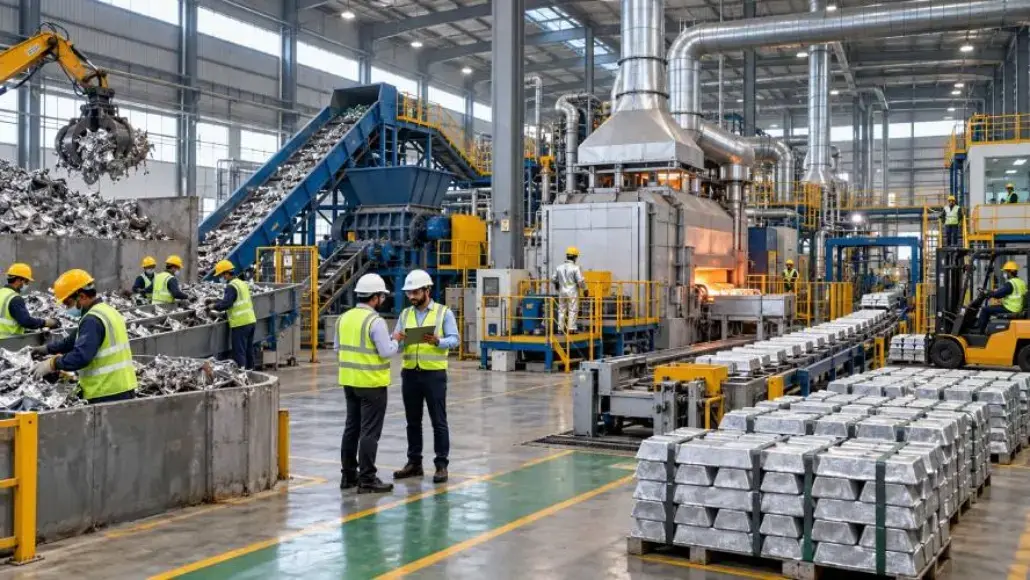
The recycled aluminium production process is organised into a sequence of ten key unit operations. The process begins with the receipt and inspection of the scrap, when the material is weighed, graded and sampled. The material is then sorted using magnets, eddy current and sensors. The scrap is shredded to make it smaller, then decoated and dried to remove paint, oil and moisture. Melting is done in rotary or reverberatory furnaces, and alloying is performed to adjust the alloy chemistry. Fluxing and degassing remove gas and oxides. Filtration removes inclusions. The final steps are casting into ingot or liquid metal, testing and dispatch. Chemistry is validated before shipping.
Two things determine profitability along this flow. The first is metal recovery. Every percentage point of aluminium lost to dross and oxidation is lost margin, so good sorting, decoating, the right furnace for each scrap type and dross recovery maximise the metal obtained from every tonne of scrap. The second is chemistry and energy control, because the cheapest additions and the best insulation and heat recovery in the furnaces keep both material and fuel costs low.
Raw Materials for Manufacturing Recycled Aluminium
The main inputs are imported and domestic aluminium scrap in many grades, alloying elements including silicon, copper and magnesium, fluxes and degassing gases and some primary aluminium for chemistry correction. Scrap is the largest cost by far, its price fluctuates with the LME and world scrap markets, and most of it is imported, so scrap purchasing is central to project planning.
The principal raw material used in the production of recycled aluminium is scrap, which forms the major part of operating expenditure. The main metal source is imported aluminium scrap from the Middle East, US, Europe and Asia, accounting for 55-62% of OpEx. Dealers, industry and vehicles provide domestic scrap, which accounts for 15-20% of the local metal supply. 4-6% of OpEx is from domestic and imported sources of alloying elements like silicon, copper and magnesium. The fluxes and degassing gases for cleaning the melt are sourced from domestic suppliers and account for 1–2%. Finally, primary aluminium for chemistry correction is purchased from domestic smelters and accounts for 1–3% of operating expenditure.
Most of India’s aluminium scrap is imported, leaving it vulnerable to export restrictions, freight costs and import duty. Cost and supply risk are addressed by buying from multiple countries, developing domestic collection networks with dealers and vehicle recyclers, signing tolling agreements with industrial customers for their process scrap, and upgrading mixed scrap by sensor-based sorting.
Location, Land and Site Infrastructure
The location of an aluminium recycling plant depends on access to ports for imported scrap, closeness to automotive and engineering foundries for sales of alloy and liquid metal and availability of fuel and power. Other factors include ability to process metals secondarily in industrial estates, environmental clearance, skilled labour and state incentives.
The location of a recycled aluminium manufacturing plant is critical, and various Indian states provide different advantages. Gujarat, which has the ports of Mundra and Kandla, has easy access to imported scrap, making it a suitable location for units that are dependent on foreign raw material. Plants in Haryana, especially in the Faridabad-Gurugram belt, are located close to auto foundry customers, ensuring regular off-take. The Chennai auto corridor in Tamil Nadu has the dual advantage of proximity to the customer and port access. Maharashtra, around Pune and Mumbai, is an auto hub with access to JNPT port. In Rajasthan, the Bhiwadi industrial area is close to the Delhi NCR market, and in Uttarakhand, Pantnagar and Haridwar have set up their plants close to two-wheeler and auto manufacturing units. Ultimately the best one is determined by whether a plant values raw material access, proximity to customers or port connectivity.
Gujarat has the best access to imported scrap with its ports, while Haryana, Tamil Nadu and Maharashtra have plants close to India’s largest automotive and engineering foundry clusters. Bhiwadi in Rajasthan and industrial areas of Uttarakhand serve northern vehicle makers. The final decision needs to consider scrap logistics, proximity to customers, fuel and power costs, environmental approvals and incentives.
Quality, Security, and Environmental Systems
Recycled aluminium must meet the specifications for alloy chemistry, gas content, inclusions and mechanical properties in terms of customer and standard specifications, tight control and full traceability being required by automotive customers. A credible plant needs an optical emission spectrometer for each melt, gas and inclusion testing, lot traceability from scrap to ingot and ISO 9001, 14001 and 45001 certification, with IATF 16949 for automotive supply. Safety is important, as molten metal can explode if it comes in contact with moisture. Scrap must be dry, and furnaces and ladles must be handled carefully. Environmental systems must control dust, fumes and dioxins from coated scrap and dross, and salt cake must be handled correctly. An experienced Recycled Aluminium Manufacturing Consultant in India can help you select the right furnaces, design pollution controls and plan the layout so your plant meets customer and regulatory requirements from the very beginning.
Major Risks & Mitigation Plans
Key risks are disruption in scrap supply and export bans from supplier countries, volatility in scrap and LME prices, import duty, poor metal recovery from bad scrap, environmental compliance, molten metal safety and customer concentration in the automotive sector. Diversification of sources and domestic supply reduces supply risk, hedging and LME-linked pricing reduce price risk, sorting and decoating reduce recovery risk, strong pollution control reduces compliance risk, dry scrap and training reduce safety risk and broadening segments reduces customer risk. Often, promoters approach a Recycled Aluminium Business Plan Consultant in India to test such scenarios before putting in capital. As lenders look closely at how scrap stocks are financed and protected against drops in metal prices, a clear buying and hedging policy established before start-up helps the case for funding.
Licences and Approvals for the Manufacturing of Recycled Aluminium in India
Approvals for an aluminium recycling plant are important as secondary metal processing is a polluting activity and scrap is imported and regulated. Promoters establishing a recycled aluminium manufacturing plant in India must have –
- Pollution Control Authorizations – Consent to Establish and Consent to Operate from State Pollution Control Board with stringent emission norms.
- Hazardous Waste Authorization –Authorisation for handling dross, salt cake and scrap imports under Hazardous and other Wastes Rules.
- Scrap Import Conformity –Import Export Code, pre-shipment inspection certificates and customs clearance for metal scrap.
- Product Standards – BIS & customer specifications for alloys, BIS certification where products are under quality control orders.
- Factory Licence & Safety –Factory licence with furnace and molten metal provisions, fire NOC.
- Quality Certifications – ISO 9001, 14001 and 45001 and IATF 16949 for automotive customers.
- Business & Trade Registrations – Business registration, GST, and Udyam wherever applicable.
Pollution control consent and hazardous waste authorization are normally on the critical path, since the plant cannot melt scrap without them. Customer approvals dictate how quickly sales grow. Parallelizing planning approvals, pollution control design, scrap sourcing and early customer sampling may reduce the time from investment decision to commercial production.
Specific approvals, registrations, and licenses, as well as certification requirements, may vary, depending on such factors as plant location, state pollution control categories, capacity, products, customer specifications, and applicable regulations. In order to make sure of complete compliance and timely execution, businesses are recommended to conduct a comprehensive regulatory review at the project planning phase.