

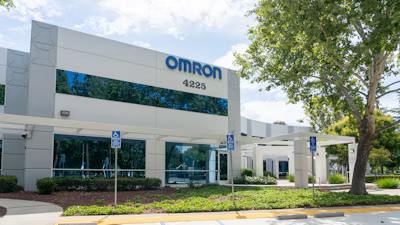

Omron has gone ahead and agreed to buy OnLogic, a US industrial computer maker, as well as its parent company Interlogic for $675 million, boosting its industrial computing capacity and speeding up the emergence of physical AI solutions in manufacturing.
The acquisition combines Omron’s advanced skills in control, motion, sensing, and robotics, as well as safety, with OnLogic’s broad line of configurable industrial computers for challenging operating environments, the announcement said. Completion is anticipated in early 2027, contingent upon regulatory approval.
The companies plan to integrate industrial automation as well as computing capacity at the edge of the network so that the manufacturers are able to handle larger volumes of machine and sensor data nearer to where production occurs. This is increasingly crucial for applications that need real-time responses as well as advanced analytics along with AI-based decision-making.
OnLogic builds durable industrial PCs for industrial automation and edge computing as well as Internet of Things applications. It is programmable and built-to-order so customers can choose computing platforms for specific operating systems and application needs.
Omron believes that the combination of these computing systems and its precision control technologies will speed up the advancement of next-generation physical AI solutions in manufacturing. The companies additionally will explore possibilities to combine industrial computers with the sensing and robotics equipment by Omron to develop solutions that bridge data processing and machine operation.
From Machine Data to Manufacturing Choices
The rising significance of edge computing for manufacturers mirrors the need to transform more complex production data into useful data rather than relying entirely on centralized cloud platforms.
In automated inspection, for instance, industrial computers can handle data collected by cameras, optical measurement systems, and various other sensors, enabling the detection of errors and variances during production.
When combined with machine controls and robotics, this enables manufacturers to react more rapidly to quality concerns.
The longer-term possibility is to link measurement outcomes directly with manufacturing decision-making processes. Dimensional inspection data can be used to adjust the process, and AI-based systems can be used to detect trends related to emerging quality problems.
But dependable closed-loop manufacturing calls for more than computational power. When inspection results are used for decisions on product conformity or process correction, measurement ambiguity, calibration, data integrity, and traceability continue to be critical.
The proposed acquisition of Omron is part of a broader industry trend toward integrating sensing, computing, and control more closely into manufacturing systems that are more closely linked together. Instead of viewing inspection, automation, and data analysis as individual tasks, manufacturers are increasingly interested in combining them into one production environment.
Maintaining OnLogic’s Independent Operation
Upon closing, OnLogic is going to continue to operate as a standalone business and will join the Omron Group. It will keep its current global offices, trademarked direct-sales model, and management team and will continue to be headquartered in South Burlington, Vermont.
The acquisition will enhance their position in North America and add capabilities that are required for increasingly connected, data-driven, and intelligent manufacturing, opines Junta Tsujinaga, Omron President and CEO.
OnLogic expects that joining Omron will provide an expanded global footprint, supply chain resources, and opportunities to broaden its industrial computing products to new markets.
The transaction is a strategic investment when it comes to the computing infrastructure behind next-generation industrial automation. Its longer-term value will be contingent on the extent to which the integrated technologies translate to real-world manufacturing applications, such as intelligent testing, flexible process control, and also data-driven quality management.