

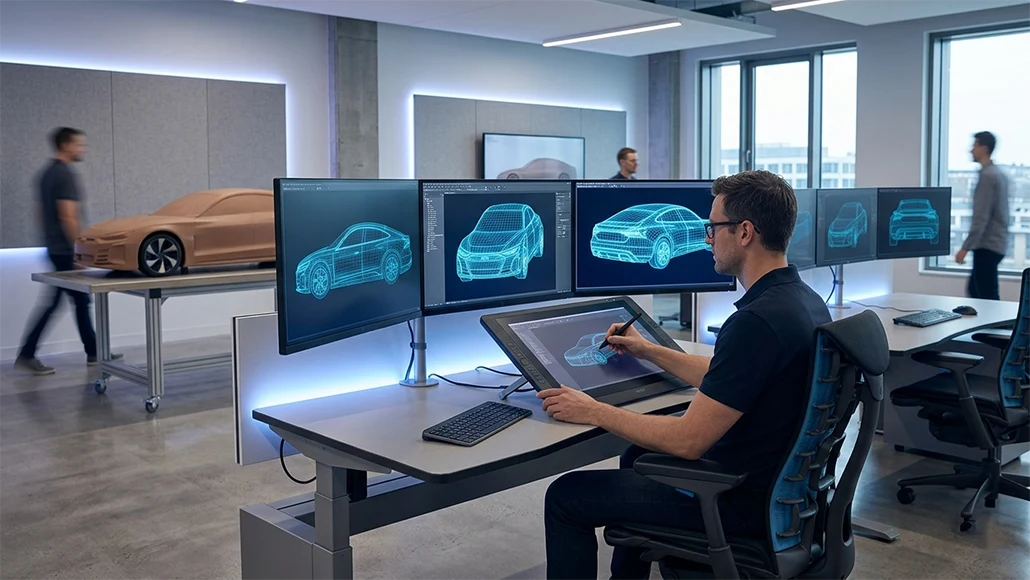

For Thomas Heermann, the world of mobility has no limits. Be it trucks, cars, or buses – it’s all mobility. Things that fly, things that drive, things that swim, said the vice president of automotive design at Autodesk during a recent trip to India.
The American company has been around for 45 years and makes software for a wide range of industries, including construction and automotive. It has a really long history with its products and lots of legacy since it started doing digital design work for General Motors.
OEMs and new starters in the mobility industry are also using its products today. This is indeed a good endorsement for their technology and for the scalability they have as well. Heermann reiterates that Autodesk is always changing and using new technologies, which are very important in the field of vehicle design.
Design is about making a car, and designers need more information, he says. Autodesk bought Navasto, which is a company based in Berlin, in 2025 so as to improve its skills in AI and simulation data. So, they can find out how car simulation works and offers Alias software designers a prediction in a matter of seconds.
This usually takes weeks and weeks, during which time the design changes. Heermann says, they haven’t just thought about design intent and aesthetics, they are also making a car.
A complete view of design
So, engineering data, crash simulations, and package data are very important, especially for electric cars. The goal is to give customers a full picture of AI-driven design workflows, not just a clay model.
Autodesk has been seeing a lot of new dynamics coming from China and India in the past few years. We get why some things are happening in the US and Europe. We talk about cars that are less than four meters long here in India. How can you fit so many design elements into this particular product? He wonders out loud, it carries five people and gets good gas mileage. He goes on to say that the most important thing is to really listen to people and understand what matters to them and what problems they are having.
Autodesk has changed how things work by connecting them from start to finish instead of just adding more features over the past few years.
The application programming interface is much more important than adding just another feature here and one more feature there. Heermann says that the company is now having a bigger-picture conversation about giving the right tools for the right designs. He mentions Tata Motors and Mahindra & Mahindra, two companies that are looking at the future of design in distinct manners. But both of them know that it matters for brand identity.
So, that makes it more and more different. You make your own future due to your brand promise and experience,” Heermann says.
Electric is a whole different game
The conversation moves on to electric vehicles – EVs and whether they make car design harder. Heermann adds that one has to have different boundary conditions here than one does with an ICE engine. You have a lot more space to play with, and it offers designers a different playground.
Some companies are really pushing EV design in different ways, and some of the things they do are completely crazy.
He adds they have customers who say their design brand is historic and will stick with the same design. From Heermann’s perspective, the good thing about EV-first companies designing cars is that the designs are a lot more fun.
The Vice President of Autodesk for India and SAARC, Kamolika Gupta Peres, says that it is very important to the company that the platform is flexible enough for all types of design, especially for younger designers.
Always set the bar higher
She says that they expect different things from how easy it is to use, how AI is used, and how well some of these platforms work with each other. They need to keep pushing the envelope on that and ensure that their platform comes with the knowledge and legacy as well as the background.
The most important thing is to help people reach their design goals for the business. Peres says that every business has a different point of view because of its brand history and strategy, as well as where it wants to go.
Everyone knows how important design is, and Peres thinks technology can be used increasingly to break down some of the barriers between departments in a company. This will make the design process more iterative while also moving more decisions to the left of the funnel. One should make decisions early on that don’t require rework, she says.
Autodesk also works with big Tier 1 and 2 suppliers like Motherson Group and Sansera Engineering, in addition to OEMs. All of them want to do business around the world with big brands as clients, so they have to meet very high standards.
More mature levels
Platforms such as Autodesk, which are also used by OEMs all over the world, automatically give these big suppliers that level of maturity as well as refinement. Peres says that they are catering to a clientele that is used to the highest standards of design excellence.
Autodesk works with other industries besides automotive, like engineering and construction, where a lot of the design work is done outside of India. This shows how important its global capability center in Bengaluru is and how much depth of talent it has.
It is well to be noted that Autodesk software was used to build the Delhi and Chennai Metro networks from the ground up. Heermann says he thinks that’s the beautiful convenience of Autodesk. They are in all these industries and connecting so many dots that no one else can.
Peres adds that it is also one of the few companies that has made all of its educational software free for colleges and universities. On top of that, they work together to teach students about their products and make sure that new graduates have the skills that businesses require.
Working with colleges and universities
Every year, a lot of STEM – Science, technology, engineering, and mathematics graduates enter the job market. Autodesk wants to help by teaching the skills that businesses need. By working with universities and getting a view from the center, this work is done.
If the government wants to improve infrastructure and digitize roads, railroads, and construction, as well as delivery, they need to improve their skills.
Peres says they triangulate this to get a better idea of where skill development needs to go.
The end goal is to teach people the skills that both the industry and the center need, which will then help India grow even more. For example, Autodesk is already working with IIT Palakkad and IIT Bombay on a project together. India is a very important market for Autodesk and a key part of its Global South program, which is about how economies work in the Global South as compared to the West.
Peres adds, a unique set of new criteria is needed to look at India, put money into it, and help it grow. India, according to him, is one of the fastest-growing markets for Autodesk around the world.
She goes on to say that investing in India means one does not just affect the local market but affects the whole world. In the future, smaller startups will also be a focus, mostly when it comes to manufacturing.
AI is the big game changer
People in many fields see AI-driven design workflows as major disruptor, even though Heermann says that Autodesk does not see it replacing people. They only use AI with their customers in ways that help them be more creative and get more done. It’s new and disruptive, but they need to use AI to get more done and reach their goals much faster than they have in the past, he adds.
He says that the best thing about it is that it connects someone who knows a lot about a field with someone who knows a lot about AI. All of a sudden, one has this kind of cross-talk, and the domain expert is inspired, and the AI person gets it and can help him.
He thinks that AI is much stronger when it is set up in the right way and people from different fields work together. Heermann adds that when math meets AI or physics meets AI, it gets really interesting.
Peres doesn’t think AI is about big language models, rather she thinks it’s about AI in the real world. It is the real world of math, physics, and gravity, as well as how buildings should be built and how a car should be designed with care and skill.
Years of research
Peres says that is the area of AI they have been researching for a long time to figure out how to make AI that can help solve a design problem with the same level of accuracy that a highly engineered solution needs.
Peres adds that this is a very different kind of AI than the one that hallucinates because hallucination can’t happen in the world of design. Autodesk put $200 million into World Labs, a Fei-Fei Li company, which is also looking into AI and design in the real world.
Peres concludes, it’s really about getting more done. Can one use AI to design a lot more cars or build a lot more buildings, roads, and bridges? Most importantly, do all of this without making mistakes, faster, and maybe even in less time. Peres says she thinks that’s the way they see AI moving forward in their field.