

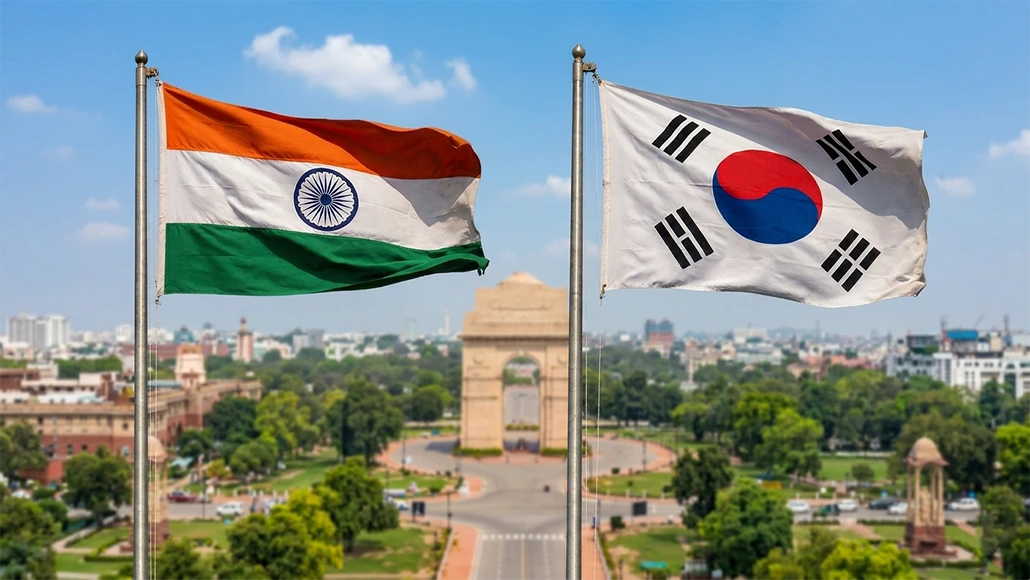

President Moon Jae-in’s recent visit to New Delhi was more than a diplomatic exchange with Prime Minister Narendra Modi. It meant India’s more vigorous effort to attract large foreign direct investment – FDI from South Korea, especially in the fields of advanced manufacturing, technology and infrastructure-related sectors.
The discussions with PM Modi showed a clear desire to enhance capital flows and not just trade. What emerged was a well-organised effort to put India as a preferred investment base when it comes to Korean conglomerates at a time when global supply chains are being rejigged.
This engagement is also part of a larger strategy where India is diversifying its sources of FDI throughout Asia and Europe along with emerging trade partners.
Targeting South Korea’s capital city
Modi-Lee talks had aimed to encourage South Korean investment in high-value sectors that matched India’s own industrial ambitions. The leaders said that the future capital of Korea will be poured into not only traditional electronics manufacturing but also semiconductors, shipbuilding, energy systems, and advanced mobility. “We will realise new opportunities for cooperation in every field, from chips to ships, talent to technology, environment to energy, and together we will ensure the progress and prosperity of both countries,” Modi said.
One of the proposals discussed was the establishment of a dedicated India-Korea startup and innovation investment fund. The mechanism is meant to channel Korean VC into India’s rapidly expanding digital and deep-tech ecosystem. Whereas previous waves of Korean investment were more concentrated on large manufacturing plants, this programme is intended to bring Korean capital into early-stage companies in AI, semiconductor design, and electric mobility software as well as industrial automation.
At the same time, there was a strong emphasis on encouraging large-scale industrial investment by the established Korean conglomerates. LG Group’s continuous and planned expansion in India, especially in electronics and consumer manufacturing, has already proven growing confidence in India as a long-term production base. The discussions also indicated the likelihood of other Korean manufacturing giants in electronics and components widening their footprint, underlining India’s desire to further develop value chains rather than be a mere final assembly hub. Another strategic pillar was ship building.
India is working with HD Hyundai, one of the world’s top shipbuilding groups, to create domestic shipyard capacity and maritime manufacturing ecosystems. And the idea is not limited to procurement but also includes co-investment in shipbuilding infrastructure and port-linked industrial clusters, as well as vessel manufacturing in India. This aligns with India’s larger objective to grow its maritime industrial base and lessen dependence on foreign-built high-value ships. The summit also saw a renewed push for greater Korean participation in India’s clean energy and industrial decarbonisation sectors.
Top executives of leading Korean business houses met PM Modi to discuss new pipelines of investment. This direct interface is increasingly becoming a hallmark of the investment diplomacy of India, allowing firms to bypass bureaucratic delays and find sector-specific opportunities.
India’s larger strategy for diversifying its sources of FDI
This South Korean investment drive is a big development, but it is only part of a larger shift in India’s foreign investment strategy. In recent years, India has been paying greater attention to diversifying its sources of FDI to reduce over-dependence on a small set of investor countries and sectors.
The important feature of this diversification is the liberalisation of investment rules, notably by way of changes in the Press Note 5 regulations relating to investments from countries sharing land borders with India, mainly China. While scrutiny remains high, India has also worked on developing clearer approval pathways for sectors considered strategically significant, reconciling national security considerations with the requirement to attract capital within electronics and renewable energy as well as infrastructure-linked manufacturing.
Japan is one of the most stable and long-term investors in India, particularly in infrastructure, automobiles and industrial corridors. In recent years, India has sought to increase Japanese participation by expanding collaboration in the Mumbai-Ahmedabad high-speed rail corridor, establishing manufacturing clusters under industrial corridor programmes and reviving interest in semiconductor and electronics supply chains. Japanese companies are also progressively being positioned as anchor investors in infrastructure financing models supported by Japanese development institutions.
India’s strategy of diversifying FDI in Europe is closely tied to current and emerging trade deals. The India-EFTA Trade and Economic Partnership Agreement is expected to open up investment commitments from countries like Switzerland, Norway and Iceland, especially when it comes to precision manufacturing, pharmaceuticals and green technologies. Similarly, the India-EU trade deal aims to boost not only trade flows but also European investment in the manufacturing and digital sectors of India. India is also working on building investment linkages with countries like New Zealand, where there have been more talks on agritech and food processing along with renewable energy collaboration. Such engagements, although on a smaller scale than many other partners, are part of India’s broader effort to expand the shareholder base across multiple geographies.
Why India Needs More Diversified FDI Inflows
Increasing foreign direct investment is crucial for India’s long-term growth and development requirements, especially the scale of capital required for infrastructure expansion, upgrading of manufacturing and the clean energy transition. But domestic investment alone will not be enough to finance highways, industrial corridors, ports, semiconductor fabs and renewable energy systems at the pace needed to sustain high growth.
Hence, FDI plays a crucial role not only in terms of providing capital but also in terms of transferring technology, integrating globally and improving productivity.
At the macroeconomic level, stable inflows of FDI help improve the balance of payments and support currency stability, thereby strengthening India’s external sector. FDI is patient capital, unlike volatile portfolio flows. It is less vulnerable to short-term financial shocks and more stable in the long run, which helps ease pressure on the rupee in times of global uncertainty. This stability is especially crucial for a developing economy that is becoming more closely integrated with the world’s financial and trade cycles.
But just as important as the size of inflows is their makeup and diversification in terms of source countries and sectors. Historically, India’s FDI profile has been exposed to concentration risks. In terms of inflows, a large share has come through a limited number of jurisdictions like Singapore, Mauritius and the United States, often on the back of tax structuring rather than operational investment from a wide range of global economies. FDI has also been heavily skewed towards services, software, trading and the financial sector, with a somewhat lower sectoral presence in deep manufacturing or high-technology industrial production.
This concentration gives rise to a series of structural vulnerabilities. India’s reliance on a small number of investor countries makes it vulnerable to shifts in geopolitics and regulation in those jurisdictions. Any alterations in tax rules, investment treaties or even global capital allocation strategies in a few economies can impact inflows to India disproportionately. Moreover, the sectoral concentration of services limits the development impact of FDI when it comes to job creation, industrial depth and export competitiveness. Services-led inflows create high-value jobs; however, they do not build large-scale industrial ecosystems or any extensive supply chains.
Hence, the diversification of sources of FDI is a strategic imperative. India’s efforts to draw capital from South Korea, Japan, the European Union, the EFTA block and emerging partners such as the Gulf economies are a continuing push to reduce dependence on traditional investment corridors. A wider investor base makes the system more resilient, strengthens the bargaining position in trade and investment negotiations and diminishes the exposure to shocks emanating from any single geography.
Equally important is the sectoral diversification of FDI, which is intimately linked with the industrial policy objectives of the country. India is indeed working hard to shift from a services-dominated FDI structure to a more manufacturing-intensive and technology-driven one. This includes electric vehicles, semiconductors, shipbuilding, green hydrogen, and advanced electronics as well as defence technology. Such sectors require large initial capital outlays and long gestation periods, making foreign participation key to accelerating scale and capability building.
Diversified sectoral inflows enhance growth quality. Manufacturing and advanced industrial investment have deeper backward and forward linkages than services, creating jobs across all skill levels and boosting domestic supply chains. They also improve India’s export performance, which is critical for maintaining stability in the external sector over the medium to long term.
In this context the specific importance of targeted partnerships such as those being sought with South Korea becomes clear. Korean investment is capital- and technology-intensive and manufacturing-heavy and hence well-suited to bridge India’s structural industrial gaps. But it is part of a wider diversification strategy that includes investment in Japanese infrastructure and European technology capital as well as emerging trade-linked FDI from a range of regions.
In short, the current FDI strategy of India is not merely about boosting inflows. It is also about altering the architecture of foreign investment to be more balanced, resilient and compatible with long-term industrial transformation, and this clear evolution of India’s investment diplomacy is evidenced by the recent Modi-Lee Jae Myung summit.